
As we know by now, collecting data is no longer enough. What makes the difference today is the ability to turn that data into fast—and above all relevant—decisions for data, marketing, or product teams.
Piano Analytics has been rolling out over the past few months a cycle of new features aimed precisely at closing that gap: custom workspaces, AI interpretation, contextual data, MCP… and soon a proactive mobile app.
To understand the logic behind these evolutions, I spoke with Mélanie Claisse — Product Manager at Piano Analytics, who has been working on data democratization for about ten years.
TL;DR — What to remember in 30 seconds
Data itself is not what’s missing. What’s missing is the path—and, above all, the context—between data and decision. Piano Analytics tackles this problem with a series of new features designed to reduce friction at every step—from collection to action.
The 4 key levers behind this evolution:
- Contextual data & event log — enriching behavioral data so it has meaning, for humans as well as for AI
- Custom workspaces — giving each team access only to what concerns them, without drowning them in information
- Reveal — an AI interpretation layer that enhances your own reading of the data and suggests concrete actions (80% positive feedback)
- Proactive mobile app (beta July 2026) — saving time by receiving data insights directly—already built, contextualized, actionable
All of this is delivered while preserving, of course, the privacy-first approach they’re known for: AI opt-out available, data hosted in Europe, full transparency on the models used.
"Privacy is still our DNA, especially with AI"

You've been at Piano for a long time. Could you introduce yourself briefly?
I've been at Piano for 17 years, and a PM for about ten years. From the start, my scope has revolved around data democratization: dashboards, Explorer, access rights—everything that helps present data as clearly as possible for very different user profiles.
AI is everywhere—both in our personal lives and, of course, at work. At Piano, how do you approach it? And how do you manage the tension with privacy, which is at the heart of your positioning?
Privacy is our DNA. That doesn’t change with AI. Our approach is to be transparent about everything and, for example, every time we use an LLM: which model, for which feature, and what data can be exposed. We have a page in our documentation that lists all of that for the whole Piano toolset. And in Piano Analytics help, for each AI feature, we specify which model is used.
In practice, we mainly work with Anthropic’s Claude, and customer data is not reused for training. All AI features are eligible for opt-out. A customer who doesn’t want AI in their organization can disable them entirely—they keep the full product, simply without the buttons and interfaces that prompt an LLM, like in Data Query or Reveal.
💬 “Every time we start a new topic with AI in it, privacy discussions come even before development.”
Is privacy a central point in roadmap items, or more of a final check at the end?
It’s really a starting point. Every time we start a new topic with AI in it, privacy discussions come even before development. We make sure we’re within the framework, that we explain clearly what we’re doing, that we’ve chosen the right models. It’s framed, and it’s intentional.
The real problem: data without context
If you had to identify the main friction points between data collection and decision-making on the customer side, what would you mention?
The first—and perhaps the most structuring—is contextualizing data. Having behavioral data is good. But behavioral data without context is hard to use—even for a human, and even more for AI. If you show an end user an unexplained traffic spike, they don’t necessarily know what to do with it. And neither does AI, if it doesn’t have the elements to interpret it.
That’s why we’ve been working for several months on what we call contextual data sources: complementary information sources we graft onto behavioral data. Today, for example, we have publication performance data from social networks—performance by content type, by theme, by mentioned person. And we’ll keep enriching that: Google Search Console, weather, other sources. The idea is to give the analyst—and the AI—the elements to explain what’s happening, not just observe it.
💬 “Context is essential both for human understanding and for AI relevance. As soon as you start naming things properly, it becomes really ultra relevant.”
And there’s also a topic around how we annotate and document events in the interface, right?
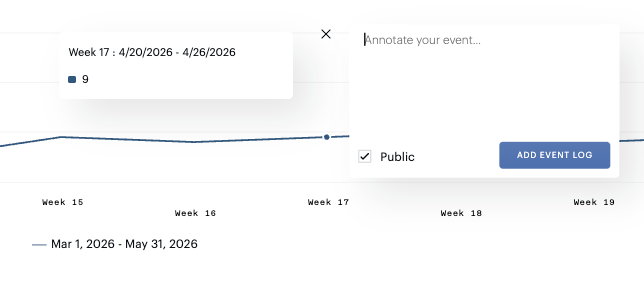
Exactly. Today in Piano Analytics we have what we call an event log—a fairly basic annotation system, where you can add a note on a date to say “today this happened.”
What we want to evolve is something much more generic: allowing customers to import events in bulk—via CSV, via API—to document what explains traffic variations, spikes, drops. That context, once it’s well structured, changes everything for interpretation.
New features that change day-to-day work
What recent evolutions have had the most concrete impact on this data → decision chain?
Several things have come out over the past few months. I’d say there are four main axes:
Onboarding — Data Sources Studio
A tagging plan tailored to each industry
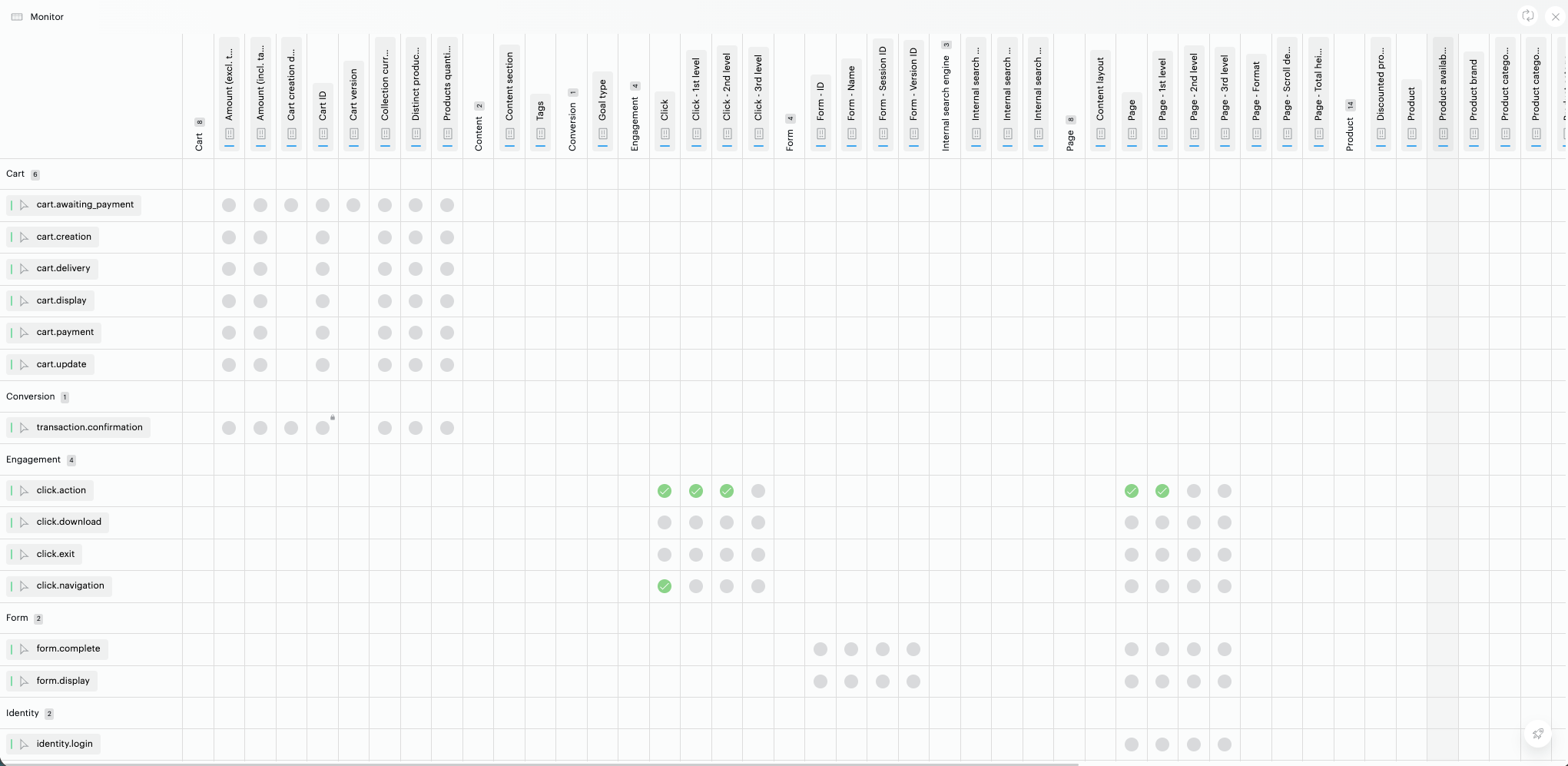
Full documentation for Data Source Studio: Data sources studio | Piano Help Center
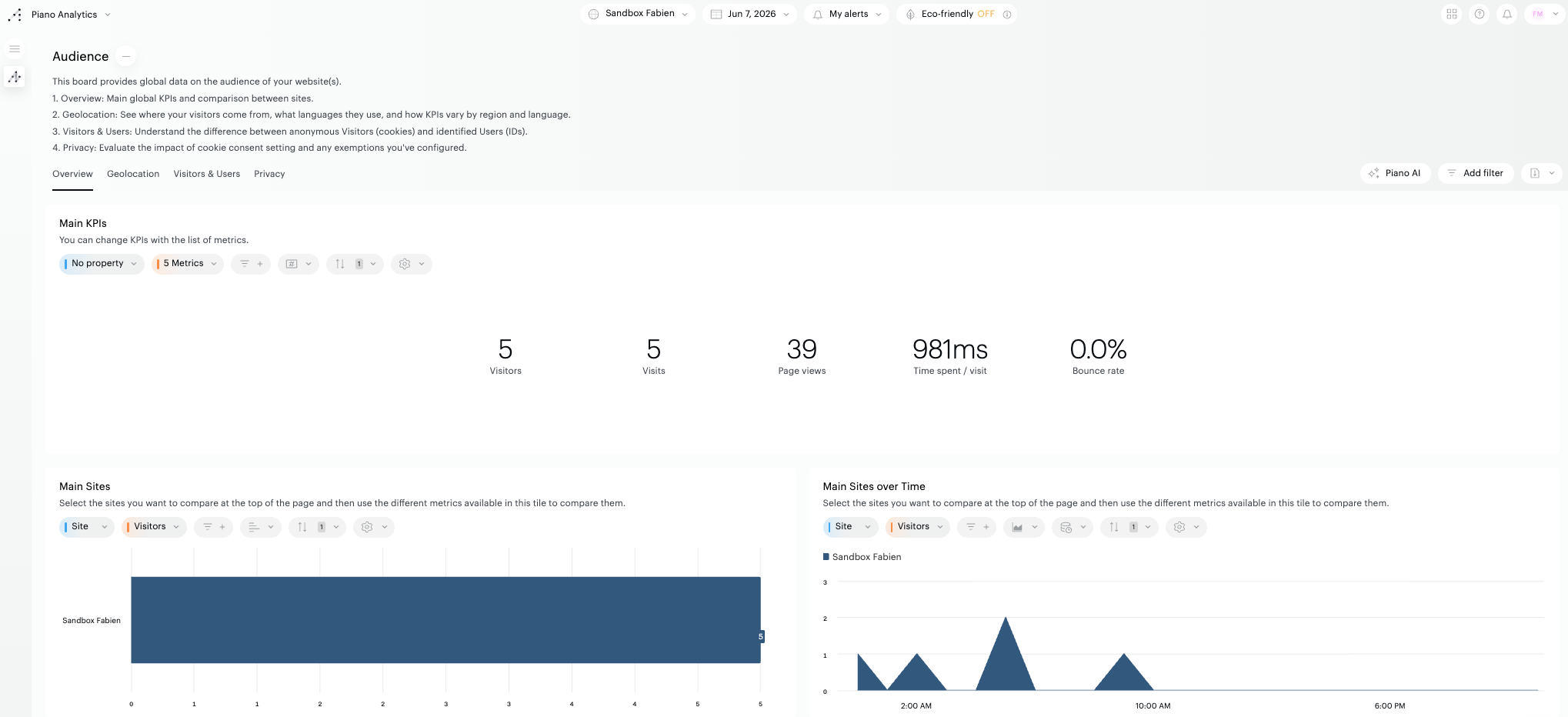
Organization — Custom workspaces
Boards tailored to each business team
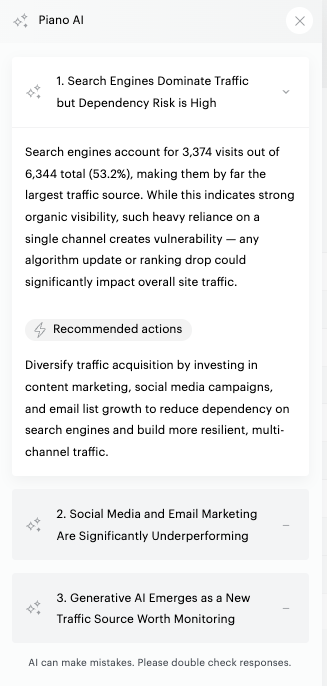
AI interpretation — Reveal
Summary and action recommendations
Automation — MCP
Integrating Piano Analytics into external workflows
Real-world usage of these features
Do you have concrete usage feedback—cases that illustrate the real value of these features?
For Reveal, the first case that comes to mind is a media customer who has been a very active user since launch. They use Reveal recommendations to steer their journalists’ content creation—Reveal analyzes performance, identifies trends, and suggests article series.
More generally, we measure satisfaction through a feedback system—was the answer helpful, yes or no—and we’re around 80% positive feedback. What’s also interesting is that usage doesn’t just hold steady: it grows over time. And Reveal is mainly used by users we identify as novices—which was precisely the goal.

💬 “My fear was that people would try it once and go back to their old life. Actually no—usage doesn’t just hold steady, it grows.”
Some customers end up with hundreds or thousands of users on Piano. How do you address that scaling challenge?
It’s a topic we keep in mind constantly. We have customers whose top 20 accounts represent several hundred users each. And when you have that many people on the platform, the question of “who sees what, and how do we avoid overload” becomes critical.
Custom workspaces address it in large part—it’s a form of access “data minimization”: each user sees exactly what they need, no more, no less.
The next step: data insights comes to you
You're talking about a feature in development that goes beyond Reveal—a kind of proactive AI. Can you tell us more?
Yes, it’s probably the most structuring topic in our short-term roadmap. We’re developing a mobile app—whose closed beta is planned for early July—which is not a mobile version of Piano Analytics in the classic sense. It’s something else.
Imagine a feed, social-network style. But instead of being fueled by friends or subscriptions, it’s fueled exclusively by insights generated by an AI. The agent will crawl the boards in your workspace, identify what’s notable—trends to investigate, opportunities, alerts—and push it directly to your phone, personalized according to your profile and your data.
The target is decision-makers who don’t go into Piano Analytics regularly—for many legitimate reasons. Today, accessing relevant information requires opening the interface, knowing which board to look at, navigating, interpreting. The app is the opposite: information comes to you, pre-digested, contextualized, actionable. And if you want to dig deeper, an integrated chat lets you ask questions directly from the feed.
💬 “Today you arrive in the interface, you wonder what to look at, you change the dates, you explore… you’re in investigation mode. That works for some people, but not for everyone. Some need to go straight to the point.”
Could we imagine a community aspect to these insights?
It’s in the ideas for later—being able to tell a colleague “look at this, it’s relevant for you” and push an insight into their feed. But that’s not the immediate focus. The priority is making sure what comes up is high quality and truly relevant.
We’ll start by crash-testing this internally, then open a closed beta in early July, and then more broadly.
In summary: what to remember
If you had to distill all of this in a few lines for teams that really want to get value from Piano Analytics today, what would you say?
Use AI with discernment, not at scale. We’re not doing AI for the sake of AI. Each feature addresses a real problem. If you use it with that mindset, it brings real value.
Invest in context. Naming your boards, tiles, and data-model elements well—documenting your events—is what makes AI truly relevant. Context is the fuel.
Prepare your governance. Custom workspaces are powerful, but they require good upfront organization: who has access to what, which resources are shared, how teams are structured. The tool can make it easier, but it doesn’t replace that thinking.
Keep privacy at the center. It’s not a compliance topic, it’s a daily fight—built in from the very start of every new AI project. Opt-out available, data in Europe, transparency on the models used: concrete commitments, not intentions.
Did you enjoy this interview? We invite you to share it on LinkedIn or your social networks!

Fabien Maury

Senior Tracking & Web Analytics Consultant at unnest, Fabien leads the expertise around Piano Analytics and manages client implementations.
After spending 3 years at Piano Analytics support, helping customers use the tool and comply with privacy guidelines. I joined unnest to take on new tracking challenges, bringing my expertise to solve complex data collection and analysis problems while respecting best confidentiality practices.
Piano Analytics / GTM / Server-side / GA4 / Google Ads
✉️ Contact me: fabien.maury@unnest.co
🎓 References: Alterna Énergie, Pichet, O2, Hello Bank, Éric Bompard, Interflora…
⚒️ Tools: Piano Analytics, GTM, GA4, Google Ads, Didomi, Axeptio, Amplitude…